Niedzica and Czorsztyn: Two Castles Facing Each Other Across a Lake
What are Niedzica and Czorsztyn castles?
Niedzica Castle, built between 1320 and 1326 as a Polish-Hungarian border fortress, stands on the southern shore of Lake Czorsztyn in the Pieniny. Directly across the water, on the northern shore, sit the ruins of Czorsztyn castle. The lake between them is a reservoir completed in 1995, covering roughly 11 square kilometres.
A border fortress and a ruin, face to face
Drive or ride along the shore of Lake Czorsztyn in the Pieniny and the two castles announce themselves before anything else does. On the southern side, Niedzica castle sits compact and largely intact on its spur above the water. Directly opposite, on the northern shore, the broken outline of Czorsztyn castle rises from a wooded hill. Nothing else in this part of Poland pairs two fortifications this way, within clear sight of each other across open water, and the pairing is the reason most visitors treat the two as a single stop rather than choosing between them.
The story behind the two sites starts long before the lake did. Niedzica was built between 1320 and 1326, at a time when the Dunajec valley here marked the edge between the Kingdom of Poland and the Kingdom of Hungary. A frontier fortress needed a rival or a counterpart on the other side, and Czorsztyn, older and now reduced to a ruin, played that role from its own hill across the valley floor.
For centuries the two watched each other over dry land, with the Dunajec river running as a modest stream in the gap between them. The lake that now separates the two castles by water is comparatively recent: a reservoir completed in 1995, covering roughly 11 square kilometres, which flooded the lower valley and turned two hilltop rivals into two lakeside landmarks.
Niedzica Castle: the fortress that survived
Niedzica is the castle still standing as a coherent building rather than a ruin. Built in 1320-1326 as a Polish-Hungarian border stronghold, it occupies a rocky spur on the southern shore, with the lake now lapping close to the base of the hill it stands on. Its walls, towers and courtyards read as a continuous structure rather than fragments, which is the main visual difference between the two sites when seen from across the water: Niedzica holds its shape, Czorsztyn does not.
This guide does not list an entry fee, opening hours, or a description of the rooms and courtyards inside Niedzica castle. Details like these change with the season and with the operator running the site in a given year, and getting them wrong in a static guide is worse than leaving them out — so treat them as something to confirm locally, at the ticket window or through the castle’s own current information, on the day of your visit rather than from anything written here.
What is safe to say, and useful for planning, is where Niedzica sits in the landscape. It looks north across the water to Czorsztyn, east and south toward the villages of the Pieniny foothills, and it is close enough to the Dunajec gorge rafting route that the two are routinely combined into one outing. The castle hill also gives one of the clearer photographic views of the lake itself, with Czorsztyn’s ruined outline visible across the water on a clear day.
Czorsztyn: the ruin on the far shore
Czorsztyn castle, on the northern shore, is the older and more damaged of the pair. Where Niedzica reads as a building, Czorsztyn reads as a ruin: broken walls, a partial tower, and open ground where roofed rooms once stood. That difference in condition is itself part of what makes the pairing worth a visit — two fortresses built to watch the same stretch of border, aged in visibly different ways, now looking at each other across a body of water that did not exist for most of their history.
As with Niedzica, this guide does not describe interior rooms, list a ticket price, or state a visiting-hours window for Czorsztyn, since none of that is settled information and it is the kind of detail that changes between seasons. Confirm timing and admission locally rather than relying on a fixed figure written months or years in advance.
Czorsztyn’s hill also gives its own view back across the lake to Niedzica, and because the ruin is more open than the intact castle opposite, the walk around its grounds tends to be the shorter and more informal of the two stops. Many visitors treat Czorsztyn as the quicker half of the pair, spending more time at Niedzica and using Czorsztyn mainly for the view back across the water.
The lake between them
Lake Czorsztyn is the detail that makes sense of everything else here. It is not a natural lake but a reservoir on the Dunajec river, completed in 1995 and covering roughly 11 square kilometres, built as part of a dam and hydroelectric project on this stretch of the river. Before the dam, the Dunajec ran through the valley floor as a river rather than filling it as a lake, and both castles stood above dry, cultivated land rather than above water.
The result today is a broad, blue expanse between the two fortresses, ringed by hills, with small boats and the general shoreline activity you would expect of a reservoir used for recreation as well as water management. The lake is also the reason the two castles are now discussed as a pair rather than as two separate stops on a map: standing on either shore, the other castle is the dominant thing in view, and the water between them is the whole point of the composition.
| Niedzica Castle | Czorsztyn Castle | |
|---|---|---|
| Built | 1320-1326 | Older than Niedzica; exact founding predates the border-fortress period |
| Shore | Southern shore of Lake Czorsztyn | Northern shore of Lake Czorsztyn |
| Condition | Largely intact structure | Ruin |
| Role historically | Polish-Hungarian border fortress | Rival fortress on the opposite bank |
| What changed in 1995 | Lake now reaches close to the castle hill | Lake now reaches close to the castle hill |
The Pieniny around the lake
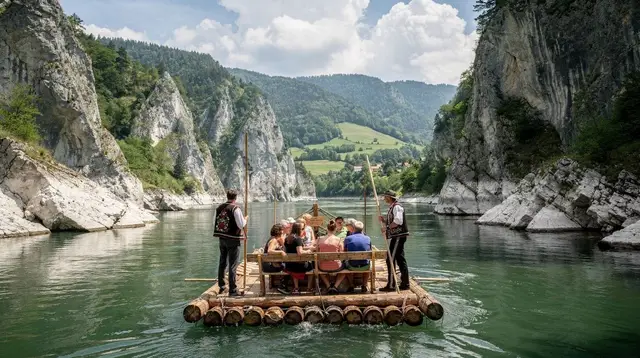
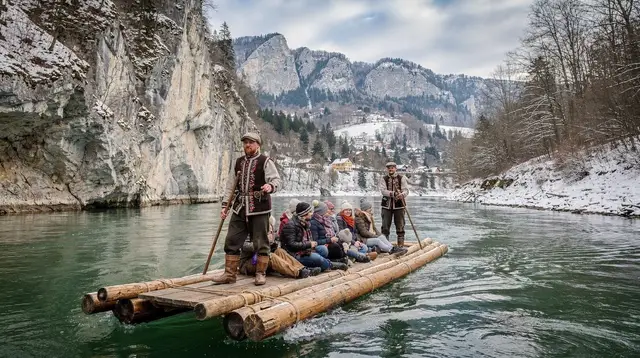
Niedzica and Czorsztyn are not isolated stops; they sit inside the wider Pieniny range, a smaller and lower set of hills than the Tatras, built on limestone rather than granite, and centred on the Dunajec river rather than on high peaks. The best-known feature of the range is the Dunajec gorge, where the river cuts through limestone walls that reach up to 300 metres, and where the traditional wooden-raft descent has run since a raftsmen’s guild dating to 1832.
That descent runs from Sromowce Niżne or Kąty downstream to Szczawnica, covering about 18 kilometres over roughly two and a half hours, with the river marking the Polish-Slovak border for part of its course. The rafting season runs from April to October, with July and August the busiest weeks.
The other landmark of the range is Trzy Korony, at 982 metres, whose viewing platform looks down over a drop of about 500 metres toward the Dunajec below. Trails to the summit start from Krościenko and from Szczawnica rather than from the lake shore, so reaching it is a separate leg of a day rather than a walk that starts at either castle. The easier alternative nearby is the Homole gorge at Jaworki, a gentler walk than the Trzy Korony ascent and one that several guided itineraries pair with the castles or with rafting on the same day.
Because all of these sites sit within a fairly compact stretch of the Pieniny, a day built around the area can reasonably include the lake and its two castles, a stretch of the Dunajec by raft or kayak, and either Trzy Korony or the Homole gorge, without needing to treat any one of them as the fixed starting point.
A guided day that already threads together Niedzica castle and the surrounding countryside removes the logistics of matching raft departure points to castle visiting windows, which is the main practical friction of planning this area independently — for a day that folds the castle into a wider outing, a guided day through the Pieniny that stops at Niedzica castle alongside the surrounding countryside covers that ground without you having to sequence the pieces yourself.
Getting there and combining the visit
Niedzica and Czorsztyn are reached by road through Nowy Targ, on the eastern side of the wider Podhale region, rather than through the Tatra National Park entrances used for Zakopane’s mountain trails. There is no cable car, funicular or rail link to either castle; the practical options are a rental car, a private transfer, or a guided day trip that includes the drive as part of the itinerary. For visitors already staying in Zakopane without a car, a guided option removes the need to arrange transport across a stretch of road that does not otherwise sit on the way to anywhere else in the Tatra itinerary.
Because the castles sit on opposite shores of the lake, reaching one from the other means driving or being driven around the water rather than walking a direct path between them; there is no footbridge or short crossing linking the two hills. Most day trips schedule both castles as separate stops on a driving loop, often with the Dunajec gorge or Szczawnica worked into the same route given how close the three sit to each other.
A day trip that already runs from Zakopane to Kraków, or that stops at the thermal baths of the Podhale, does not typically also reach as far as the Pieniny — the castles and the gorge sit in a different direction from those routes, closer to Kraków by road than to the ski areas around Zakopane. Anyone planning to see Niedzica, Czorsztyn and the Dunajec together should treat it as its own day, or as the anchor of a short Pieniny loop over two days, rather than folding it into a day already built around the high Tatras.
Combining with the Dunajec and the gorge
The pairing of castles and river is the natural way to spend a full day in this part of the Pieniny, and several guided options are built specifically around that combination. A traditional raft descent on the Dunajec, using the flat wooden rafts that have carried passengers through the gorge since the nineteenth century, gives a different vantage point on the same landscape the castles overlook — from the river rather than from the hilltops.
For visitors who want that river time built around the castle stop, a traditional wooden-raft descent of the Dunajec gorge departing from Zakopane covers the river portion of the day, while a guided wooden-raft cruise through the gorge is a similar option run with its own scheduling and pickup points, worth comparing against the first if your base is closer to Szczawnica than to Zakopane.
Visitors approaching from the Szczawnica side of the gorge, rather than from Zakopane, have their own local departures to weigh. A Dunajec rafting departure based in Szczawnica itself sits closer to the lake and the castles than the Zakopane-based options, which can shorten the driving portion of a day that already includes Niedzica and Czorsztyn.
For a different kind of walking day in the same range, the Homole gorge near Jaworki is the gentler counterpart to the Trzy Korony ascent, and a guided walk through the Homole gorge at Jaworki is one way to add a walking element to a day otherwise spent around the lake and the river, without committing to the longer climb to the Trzy Korony viewpoint.
Practical notes
Poland uses the złoty (PLN); the country is outside the eurozone, and that applies across the whole Pieniny area, including at both castles and along the rafting route. Cards are widely accepted at larger operators and ticket points, but cash still matters at smaller stalls, raft embarkation points and village cafés around the lake, much as it does elsewhere in the Podhale. If a day trip crosses into Slovakia — for the Slovak Tatras or a border day trip rather than this specific Pieniny loop — euros come into play instead, but a Niedzica-Czorsztyn-Dunajec day on the Polish side stays entirely in złoty.
Time zone, emergency numbers and the general practicalities of travelling in this part of Poland match the rest of the Zakopane area: Central European Time, the emergency number 112, and drinkable tap water. The Pieniny is lower and gentler terrain than the high Tatras, without the entry-ticket system, chained ascents or altitude concerns that apply inside the Tatra National Park, so a day here does not require the same planning around trail closures or mountain weather that a Morskie Oko or Giewont day does.
It does still call for ordinary road-trip planning: confirming which castle, which raft departure, and which combination of stops fits the time available, since the three main draws of the area — Niedzica, Czorsztyn and the Dunajec gorge — sit close enough together to combine, but not close enough to see on foot in a single loop.
For a wider view of how this day fits against the rest of a Zakopane-based trip, see the Dunajec gorge and Pieniny day-trip planning guide, the complete Dunajec rafting guide, and notes on choosing the best season to avoid crowds on the river.
Travellers building a longer route through the region can also look at the Slovak side of the Tatras for how a Pieniny day connects to a longer loop, and the general things to do around Szczawnica and around the Dunajec gorge for other stops in the same area. Broader planning notes for the region sit on the travel tips hub, and the castles themselves are grouped with other Pieniny sites under things to do: Pieniny castles.
Pieniny and castle tours
Verified deep-linked GetYourGuide tours. Book through these links and we earn a small commission at no cost to you.
GetYourGuide does not provide a product photo for this activity — the image shows the meeting point, photographed by us.