Dunajec Gorge and the Pieniny: Planning a Day Trip
Can the Dunajec raft trip and the Pieniny castles be done in a single day?
Yes — the wooden-raft descent from Sromowce Niżne or Kąty to Szczawnica (18 km, about 2.5 hours, running 1 April to 31 October), Niedzica castle facing the Czorsztyn ruins across Lake Czorsztyn, and the Trzy Korony viewpoint sit close enough together to combine. None of them publish a joint schedule or a combined ticket, so the order and timing are yours to plan around opening hours and the raft's season.
Three sights, one valley
The Pieniny pack an unusual amount into a small stretch of the Polish-Slovak border: a river gorge you descend by raft, a medieval castle facing a ruin across a reservoir, and a limestone summit with a platform over a 500 m drop.
All three sit within a short drive of each other, on or near Lake Czorsztyn, which is why so many visitors ask whether the Dunajec, Niedzica castle and Trzy Korony can be combined into a single day. The short answer is that geography makes it possible. What follows is what each place actually involves, so you can build the day around opening hours and the season rather than around a timetable that does not exist.
This page will not hand you a fixed itinerary with departure times, because no such thing is published anywhere in the region. There is no single ticket that covers the raft, the castle and the national park trail together, and no shuttle that links the three on a fixed schedule. The raftsmen’s guild runs the river, the castle keeps its own opening hours, and Trzy Korony is a marked trail inside Pieniński Park Narodowy with its own entry fee. Planning this day means understanding each piece on its own terms, then deciding how much of it fits into the time you have.
The wooden-raft descent on the Dunajec
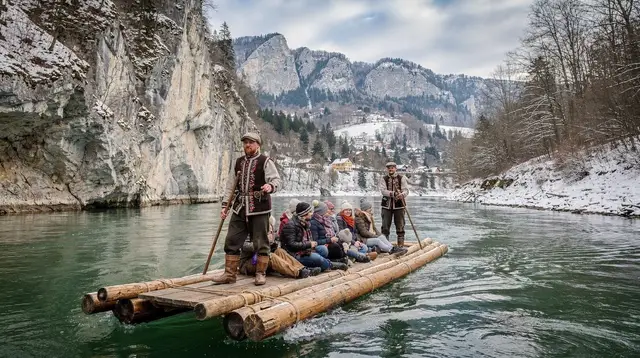
The centrepiece for most visitors is the raft trip on the Dunajec itself. Flat wooden rafts, each carrying 10 to 12 passengers and steered by two raftsmen with long poles, leave from Sromowce Niżne or Kąty and cover about 18 km to Szczawnica in roughly 2.5 hours. The rafts belong to a guild of local raftsmen whose trade dates back to 1832, and the poling technique has barely changed since. For a stretch of the route the river marks the border between Poland and Slovakia, and the limestone walls of the gorge rise as high as 300 m above the water on either bank.
The season runs from 1 April to 31 October. Outside that window the rafts do not operate, which is the first constraint that shapes any plan for this day: a Dunajec-Pieniny day trip is a warm-season trip, not a year-round one. Within the season, July and August bring the heaviest demand, and queues at the departure points can form well before midday. Alongside the traditional wooden rafts, pontoon rafting and kayaks run the same stretch of river for visitors who want a faster or more active alternative — see the full comparison in the Dunajec river rafting guide and the notes on when to go to avoid the crowds.
Several tour formats bundle the raft with other elements of the Pieniny. A Pieniny day tour that pairs the mountains with a stop at Niedzica castle and a taste of local food covers the raft alongside the castle in one outing, which is one practical way to see both without arranging separate transport.
For visitors who want the traditional experience without the extras, a guided wooden-raft cruise on the Dunajec keeps the focus on the river itself. Departure points, raft capacity and the poling technique are covered in more depth in the rafting guide, and the seasonal detail — when the water is highest, when the queues are shortest — is in the best-season guide.
Niedzica castle and the ruins across the water
A short distance from the raft’s departure points, on the shore of Lake Czorsztyn, stands Niedzica castle. Built between 1320 and 1326 as a fortress on the border between Poland and the Kingdom of Hungary, it is the intact half of a pair: on the opposite shore, the ruins of Czorsztyn castle face it across the water. The two castles were built to watch the same stretch of the Dunajec valley from either side, and for centuries they marked two different kingdoms rather than two viewpoints of the same one.
The lake between them is not a natural feature. It is a reservoir, completed in 1995, covering roughly 11 square kilometres. Before the dam was built, the valley floor between the two castles was dry land, and the river ran in a narrower channel below both fortresses. The reservoir changed the relationship between the two sites: what was once a valley crossing is now a stretch of open water, with Niedzica’s walls reflected in it and Czorsztyn’s ruins visible on the far bank.
Niedzica castle is the one visitors walk through; Czorsztyn’s ruins are viewed from a distance or reached separately along the lakeshore. Between the two, and the walking paths that link them to the reservoir’s edge, this corner of the Pieniny rewards an hour or two on foot as much as it does a single stop for photographs. The full detail on opening arrangements, the walk between the two castles, and what each site actually contains is in the Niedzica and Czorsztyn castles guide. The wider destination page for Niedzica and Czorsztyn sets the two castles in the context of the lake and the surrounding villages.
Trzy Korony: the view above the gorge
The third element of the day is Trzy Korony — “Three Crowns” — the highest point of the Polish Pieniny at 982 m. A viewing platform near the summit sits above a drop of roughly 500 m down to the Dunajec gorge, and on a clear day the view takes in the river’s loops below, the Tatras on the southern horizon, and the Slovak side of the Pieniny across the border. The trail up is inside the Pieniny National Park, which — like the Tatra National Park to the south — charges its own entry fee and restricts walkers to marked paths.
Trzy Korony is usually approached from Szczawnica, the town at the end of the raft route, which makes the sequence of raft-then-summit a natural one for visitors who want to walk off the two and a half hours spent sitting on a wooden raft.
It is not the only option: trailheads on other sides of the massif reach the same viewpoint from different directions, and the nearby Homole gorge near Jaworki offers a gentler walk for those who want a Pieniny hike without the climb to the summit — covered in the guided walk through the Homole gorge at Jaworki. The climb to the platform itself, timing, and what the trail involves are set out in full in the Trzy Korony and Homole gorge hiking guide.
Getting there, from Kraków or from Zakopane
Both of the region’s usual bases reach the Pieniny by road, and neither is a short hop.
| From | Distance | Typical journey |
|---|---|---|
| Kraków | about 110 km | roughly 2 to 2.5 hours by bus |
| Zakopane | shorter, via Nowy Targ | no fixed public timetable published for this route |
Kraków is the gateway most visitors arrive through, with KRK airport and frequent bus services toward the mountains; the general options for covering that distance — bus, train or car — are laid out in the Kraków to Zakopane transport guide, and the question of whether a Pieniny detour is worth adding to a Kraków-based trip is addressed directly in the Kraków day trip guide. Travellers based in Zakopane reach the Pieniny by the roads through Nowy Targ, on the western side of the region, without needing to route through Kraków at all.
Either way, the raft’s departure points at Sromowce Niżne and Kąty, Niedzica castle on the lakeshore, and Szczawnica at the end of the raft route are all within a short drive of one another — close enough that a single day covering more than one of them is realistic, but far enough from both Kraków and Zakopane that the journey itself takes up a meaningful part of that day. Anyone weighing whether to base the whole day around the Pieniny or fold it into a longer stay in the region should read the two-day Pieniny and Dunajec itinerary, which spreads the same sights over two days rather than compressing them into one.
What this day does not come with
It is worth being direct about what is not published, so expectations match what is actually on the ground:
- No fixed order. Nothing in the region prescribes whether to raft first and see the castles after, or the reverse. The raft ends in Szczawnica, some distance from the castles by Lake Czorsztyn, so the choice of order affects how the day’s driving is arranged.
- No combined ticket. The raft, Niedzica castle’s entry fee, and the Pieniny National Park fee for the Trzy Korony trail are three separate payments at three separate points, not one pass covering all of them.
- No dedicated shuttle linking the raft’s end point in Szczawnica back to a car or bus left near the departure points, or on to the castles. Getting between the pieces of this day is left to the visitor, whether by car, by an organized tour that includes transport, or by the public bus network that serves the Pieniny villages.
None of this makes the day impossible — it simply means the planning sits with the traveller rather than with a published route. An organized tour that bundles the raft with a stop at the castle, such as the Pieniny day tour covering both the mountains and Niedzica castle, removes some of that planning by fixing the transport and the order in advance, in exchange for following someone else’s schedule rather than your own.
Building your own version of the day
Given the constraints above, most visitors end up choosing which two of the three sights matter most rather than forcing all three into one day. A traveller short on time might raft the Dunajec and stop at Niedzica castle on the way back, leaving Trzy Korony for a future visit. A hiker might prioritize the summit and the Homole gorge, treating the raft as optional. A family with young children might find the castle and the lakeshore walk enough on their own, without the physical demands of either the raft queues in peak season or the climb to Trzy Korony.
What ties the three together, and what makes this corner of the Pieniny worth the drive from either Kraków or Zakopane, is the Dunajec itself: it is the river the raft descends, the river the two castles once guarded from opposite banks before the reservoir changed the valley, and the river the view from Trzy Korony looks down on from 500 m above. Seeing even two of the three gives a sense of the gorge from more than one angle — from the water, from a fortress wall, or from a viewing platform in the sky — which is more than most single-attraction stops in the region offer.
For a full traditional-raft option that keeps the day simple, the wooden-raft cruise on the Dunajec with a guide is the closest thing to the classic experience the guild has offered since 1832, and it leaves the rest of the day — the castles, the summit, or neither — entirely open.
Dunajec Gorge and Pieniny day trip: frequently asked questions
How far is the Dunajec Gorge and Pieniny area from Kraków?
About 110 km by road, and roughly 2 to 2.5 hours by bus on the services that run to the region; driving takes longer once you leave the main road for Niedzica, Czorsztyn or the raft departure points at Sromowce Niżne and Kąty.
Can I raft the Dunajec and visit Niedzica castle on the same day?
Both sit within a few kilometres of each other on Lake Czorsztyn’s shore, so a same-day visit is physically possible. Neither the raftsmen’s guild nor the castle publishes a joint schedule or combined ticket, so the order and timing are left to the visitor to plan around the raft’s operating hours and the castle’s opening times.
When does the Dunajec raft trip run?
The wooden-raft season runs from 1 April to 31 October. The 18 km descent from Sromowce Niżne or Kąty to Szczawnica takes about 2.5 hours, with two raftsmen poling a flat wooden raft carrying 10 to 12 passengers through a limestone gorge whose walls reach 300 m.
What is the difference between Niedzica castle and Czorsztyn castle?
Niedzica castle, built 1320 to 1326 as a Polish-Hungarian border fortress, still stands intact on one shore of Lake Czorsztyn. Czorsztyn castle, on the opposite shore, is a ruin. The lake between them is a reservoir completed in 1995, covering about 11 square kilometres.
What is Trzy Korony and how do you reach the viewpoint?
Trzy Korony, at 982 m, is a Pieniny summit with a viewing platform set above a 500 m drop over the Dunajec gorge, reached on foot from Szczawnica or from trailheads on the Pieniny side of the valley.
Is there a combined ticket for the raft, the castles and Trzy Korony?
No single combined ticket covers all three. Each is booked or paid for separately: the raft trip, entry to Niedzica castle, and the national park fee for the Trzy Korony trail.
Can this day trip be done from Zakopane instead of Kraków?
Yes. Zakopane sits closer to the Pieniny than Kraków does, and the same three sights — the raft, the castles at Czorsztyn, and Trzy Korony — are reached from Zakopane by the roads through Nowy Targ, without needing to pass through Kraków first.
Do I need to book the Dunajec raft trip in advance?
Raft places are organized at the departure points in Sromowce Niżne and Kąty, and demand rises sharply in July and August. On peak-season days the safer approach is to arrive early or secure a seat as part of an organized tour rather than expect a place on arrival in the middle of the day.
Popular day trips
Verified deep-linked GetYourGuide tours. Book through these links and we earn a small commission at no cost to you.
GetYourGuide does not provide a product photo for this activity — the image shows the meeting point, photographed by us.