Most visitors reach Szczawnica by river, not by road, and that changes the question worth asking about the place. It is not “what is there to see in Szczawnica” so much as “the raft has just landed — now what.” This page answers that, and the practical half that guidebooks tend to skip: how the Dunajec gorge crossing actually works, why it is not a there-and-back excursion, and what to do with the rest of the day once you are standing on the Szczawnica bank.
A one-way river, not a round trip
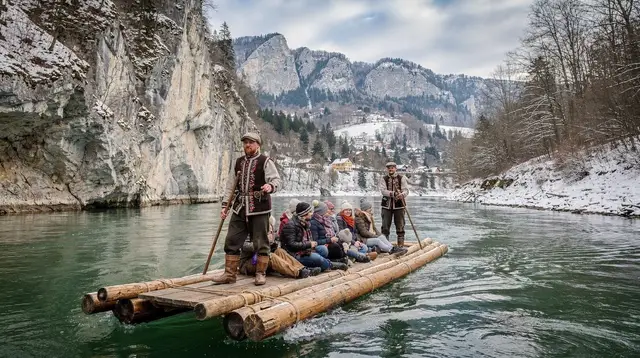
The traditional wooden rafts — flat, poled by two raftsmen from a guild with roots back to 1832 — run downstream only, from Sromowce Niżne or Kąty to Szczawnica, about 18 km and 2.5 hours through a limestone gorge whose walls rise up to 300 m on each side. The Dunajec itself forms the Polish-Slovak border for a stretch of that run, so part of the scenery on one bank is a different country. The full route, with context on both ends, is covered on the Dunajec gorge destination page and in the complete rafting guide.
The detail that trips people up: Szczawnica and Sromowce are the two ends of one linear route. There is no raft going back upstream, and no road that retraces the river in reverse in any useful way. If you drove yourself to the Sromowce car park, you need a plan to get back to it — a shuttle bus, a taxi, or an organised tour that already includes the return leg. If you arrived in Szczawnica independently, meaning to raft “from” there, that is the wrong end of the trip: you would need to travel to Sromowce or Kąty first, raft down, and end up back where you started travel-wise, in Szczawnica. Planning the whole loop before setting out is covered in the Pieniny day-trip planning guide.
The simplest fix for most visitors is to let someone else own that logistics problem: an a guided wooden-raft cruise down the Dunajec typically collects you, drives you to the upstream starting point, puts you on the raft, and brings you back from Szczawnica by coach — the whole loop handled as one booking rather than three separate ones.
Sromowce Niżne or Kąty: does the starting point matter?
Most operators launch from one of two villages upstream, Sromowce Niżne or Kąty, a few kilometres apart on the same stretch of river, and for a visitor who ends up in Szczawnica the difference is negligible. Both routes finish at the same landing, on rafts poled by the same guild of raftsmen, through the same gorge. What actually varies is which jetty a given tour or ticket happens to use — usually decided by where the operator’s buses are running that morning rather than by anything worth choosing between.
There is no meaningful upgrade in insisting on one starting village over the other, and a traveller booking independently gains nothing by shopping around for it. The detail worth fixing in advance is the return transport out of Szczawnica, covered below, not which of the two nearly identical embarkation points the raft happens to leave from.
What the raft trip actually involves
| Detail | What to expect |
|---|---|
| Starting points | Sromowce Niżne or Kąty |
| Finish | Szczawnica |
| Distance | About 18 km |
| Duration | About 2.5 hours on the water |
| Season | 1 April to 31 October only |
| Busiest months | July and August |
| Crew | Two raftsmen with poles per raft |
| Group size per raft | Around 10-12 passengers |
The rafts are flat wooden platforms, not inflatable dinghies, and the pace is a drift rather than white water — the interest is the scenery, the gorge walls, and the raftsmen’s running commentary, some of it sung. Life jackets are provided and worn throughout. July and August bring queues at the embarkation point and a livelier atmosphere on the water; late spring and September thin the crowds without losing the gorge’s colour. The season-by-season trade-offs, including why the rafts stop entirely from November to March, are laid out in the best season and crowds guide — worth reading before booking a winter date that simply will not run.
For a faster, more active version of the same gorge, some operators sell it as a kayaking descent of the Dunajec with transfer included, which covers similar water with more paddling and less drifting, and comes with its own transport back built into the booking.
Boarding is not step-free on either end of the trip. Getting onto a raft means a step down from a wooden landing platform, with no ramp and limited room to manoeuvre a wheelchair or a bulky stroller, and the crew’s job is steering and poling, not lifting heavy equipment aboard. Anyone travelling with reduced mobility or very young children in a pram should plan around that step rather than assume the calm water means an easy boarding.
Getting back from Szczawnica
This is the part worth settling before the day starts, not after landing. Three realistic options:
- Book a trip that includes the return. Most organised rafting day trips, including a rafting adventure that bundles the river crossing with the coach back, drive you to the starting point, raft you down, and coach you back to your pick-up point — the whole loop is one line item, and nothing needs improvising in Szczawnica itself.
- Public or private transport. Local buses and minibuses connect Szczawnica back towards Nowy Targ and on to Zakopane, but schedules thin out in the evening; a pre-booked taxi is the reliable fallback if you are travelling independently and left a car at Sromowce.
- Stay in Szczawnica. Since the town has its own small centre and is a starting point for the Homole gorge and the wider Pieniny, an overnight here turns the raft trip into the first half of a short stay rather than a single long day — see the two-day Pieniny and Dunajec itinerary for how that splits across two days.
What does not work is treating Szczawnica as a place you can drive to, raft “there and back” from, and leave the same hour — the river only goes one way, and the road journey between the two ends takes real time too.
What the landing point is actually like
The Szczawnica landing does not feel remote, and it is worth arriving with that expectation set correctly. Through the July-August peak, rafts come in one after another, and the jetty area is lined with souvenir stalls, food stands selling oscypek and kwaśnica, and photographers selling printed shots of the raft mid-descent — none of it compulsory, but none of it a quiet-river surprise either once you have paid for the trip. Queues build at both ends: at the Sromowce embarkation point before boarding, and at the Szczawnica jetty if a coach transfer runs on a fixed schedule rather than leaving whenever it fills.
Neither queue is long by the standards of a peak-season morning at Morskie Oko. The more common mismatch is expectation rather than inconvenience: visitors who picture a remote mountain river landing and instead find a small, well-organised tourist economy in full swing at the water’s edge.
Homole gorge, the easy walk from Jaworki
Once the rafting part of the day is done, the Homole gorge is the natural next stop, a short limestone ravine reached from the village of Jaworki, a few kilometres east of Szczawnica by local bus or taxi. The walk itself is easy — a well-marked path along a stream bed between narrowing rock walls — and manageable for most fitness levels and older children, unlike the chained ridges further south in the High Tatras. Full route notes, timing and what to expect underfoot are in the Trzy Korony and Homole gorge hike guide.
The gorge path itself is gravel, gently graded and mostly flat, which makes it workable with an off-road buggy, but it narrows between the rock walls in places and is not a route a standard wheelchair can manage. It is a walk built for legs, not wheels.
Several operators pair the two halves of the day into one booking, such as a guided walk through the Homole gorge, which removes the need to work out Jaworki’s bus timetable on the day. For visitors who want a livelier finish instead, an a combined rafting run and alpine-coaster descent swaps the gentle gorge walk for a faster ride back down the hillside near the raft landing.
Trzy Korony and the wider Pieniny
If the day is already built around the round trip from Zakopane or Kraków, the honest choice is between the gorge walk and the Trzy Korony viewpoint, not both — there usually is not time for a third activity once the rafting and the transfers are accounted for. The gorge suits families, limited time and easy walking; the viewpoint suits travellers willing to add another hour or two of climbing for the panorama, ideally on a day set aside for the Pieniny alone rather than squeezed after a river crossing.
Above Szczawnica and the gorge, the Trzy Korony viewpoint (982 m) looks out over the whole Dunajec loop from a platform set above a 500 m drop — one of the better panoramas in the Pieniny for relatively little climbing effort, and a natural pairing with a day already built around the river.
Further along the valley, Niedzica castle, built in the 1320s as a Polish-Hungarian border fortress, faces the ruins of Czorsztyn castle across the Czorsztyn reservoir; both are covered together on the Niedzica and Czorsztyn destination page and in the castles guide. None of this is walkable from Szczawnica in an afternoon alongside the rafting — it belongs on a second day, or a trip built specifically around the Pieniny castles category.
Szczawnica the spa town, beyond the river
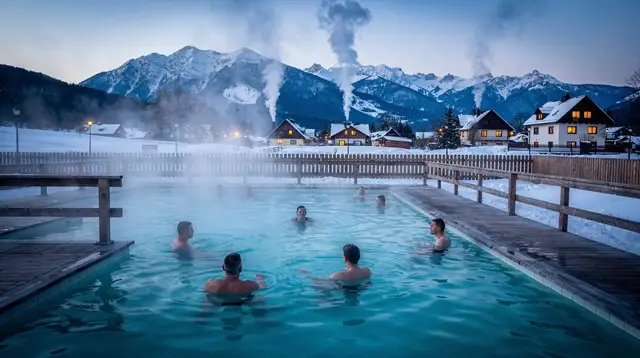
Away from the jetty, Szczawnica is also one of Poland’s older health resorts, built around sulphate mineral springs that draw a separate, quieter kind of visitor than the rafting crowd. A promenade lined with pump rooms (pijalnie wód) runs through the town centre, where the spa tradition means sipping mineral water on a walk rather than bathing in it — this is not a thermal-baths stop on the model of Chochołów or Białka Tatrzańska, and anyone expecting pools here will be disappointed.
On the hillside opposite the Homole side of town, a gondola lift climbs Palenica, with a summer toboggan run and marked walking and biking trails at the top. It runs on its own ticket and its own schedule, entirely separate from the rafting operators, and makes more sense for travellers staying overnight in Szczawnica than for those passing through on a single day trip from Zakopane with a coach already waiting.
Getting to Szczawnica from Zakopane and Kraków
| From | Approximate time | Notes |
|---|---|---|
| Zakopane | About 1.5-2 hours by road | Via Nowy Targ; public transport takes longer with a change |
| Kraków | About 2.5-3 hours by road | Often sold as a combined Dunajec day trip |
| Sromowce / Kąty (raft start) | About 2.5 hours by water | The raft itself, not a road transfer |
Szczawnica sits east of Zakopane rather than directly on the route to Kraków, so it is usually visited as a dedicated day out rather than tacked onto another destination. The road and transport options between Zakopane and the wider region, including where the Zakopianka gets congested, are detailed on the Kraków to Zakopane transport guide; travellers based in Kraków instead should start from the Kraków day-trip guide, which covers the same Dunajec route from the other end.
Either base, the Dunajec gorge activity page lists the operators covering this stretch, and the rafting category narrows that down to the river trip alone.
Travellers building a longer route through the region rather than a single day trip should look at the seven-day Tatras and Pieniny Slovakia itinerary, which places Szczawnica and the Dunajec inside a wider loop rather than as an isolated outing from Zakopane.
When to go
The rafting season runs from 1 April to 31 October; outside those dates the rafts are simply not on the water, and no amount of planning changes that. Within the season:
- April-May: cooler water and air, fewer crowds, the gorge still green from spring rain.
- June: a comfortable middle ground before the summer peak.
- July-August: the busiest weeks, queues at the embarkation point, book ahead.
- September-early October: quieter again, with the Pieniny’s autumn colour on the gorge walls — a strong pairing with the same season further south in the High Tatras.
What Szczawnica is not
Szczawnica is not a High Tatra base: it sits in the Pieniny, a separate and much lower range, and it is not where you go for chained ridges or glacial lakes — that is Zakopane and the national park to its south. It is not a year-round rafting destination: the season closes completely from November to March. And it is not a place to treat the river as a there-and-back trip — the wooden rafts run one direction only, and the return journey from Szczawnica to wherever the day began has to be arranged, not assumed.
Szczawnica and the Dunajec raft trip: frequently asked questions
Is Szczawnica where the Dunajec raft trip starts or ends?
It ends there. The wooden rafts push off from Sromowce Niżne or Kąty, downstream, and land in Szczawnica about 2.5 hours later. Nobody rafts the other way.
Can I raft the Dunajec in winter?
No. The rafting season runs from 1 April to 31 October. Outside that window the rafts are not on the water, whatever a tour listing elsewhere might imply.
How do I get back to my car or hotel after the raft lands in Szczawnica?
You arrange it before you start. Organised trips include a coach transfer back to the starting car park; travelling independently means booking your own return bus, taxi or shuttle in advance, since Szczawnica and Sromowce are roughly 18 river km apart by road too.
Is the Homole gorge walk in Szczawnica itself?
No, it starts in Jaworki, a village east of Szczawnica reached by local bus or taxi, and the gorge walk itself is short and easy, well within reach of most visitors.
Is the Dunajec rafting trip suitable for young children?
Most operators accept children from about 4-5 years old with an adult, life jackets are provided, and the ride is calm rather than white-water, but always check the age policy of the specific booking.
Can I visit Szczawnica as a day trip from Zakopane without a car?
Yes — most visitors book an organised rafting day trip that collects them in Zakopane, handles both ends of the river journey, and returns them the same evening, which is simpler than piecing together local buses.
Are there other things to do in Szczawnica besides the rafting?
The Homole gorge, the wider Pieniny hills around Trzy Korony, and the small spa-town centre itself are the main options; it is not a base for High Tatra hiking, which lies well to the south.