Zakopane Style: The Architecture That Saved a Town
I used to assume the pointed roofs and carved wooden balconies around Zakopane’s old streets were decoration - the kind of thing a town leans on once it starts living off visitors, the way a ski resort anywhere grows fake chalet fronts to look the part. It took me an afternoon at Villa Koliba to realize I had it backwards. The style came first. The tourism came after and, for once, adapted to the architecture rather than the other way around.
A Style, Not a Decoration
The man responsible was Stanisław Witkiewicz, a painter and critic who came to Zakopane for his tuberculosis in the 1880s, the way half the town’s early history reads - people arriving for the mountain air and staying for something else. What he found in the surrounding Podhale villages wasn’t quaint.
It was a serious carpentry tradition: log construction, steep roofs built to shed heavy snow, joints cut without nails. Witkiewicz didn’t sketch it as folklore. He studied it as a builder would, then set out to formalize it into an architectural style with its own rules - proportions, roof pitches, a vocabulary of carved sun motifs and geometric borders that could be applied consistently rather than improvised per house.
The first result was Villa Koliba, built between 1892 and 1894, and it’s the building I’d point anyone toward first. It now holds the Museum of the Zakopane Style, part of the Tatra Museum network founded back in 1888, and walking through it is the fastest way to see the difference between “wooden house” and “Witkiewicz house” in one visit. The steep roofline, the carved gable, the covered porch with its turned posts - none of it is arbitrary.
It reads like a system once you’ve seen one example, and then you start noticing it everywhere along the older parts of Krupówki and the streets branching off it. It also makes that street a better stop than the souvenir stalls most visitors default to - worth pairing with a look at the tourist-trap mistakes that trip up a first visit to Krupówki.
What Else Carries the Style
Two other buildings show the range of what Witkiewicz and his followers built. The Jaszczurówka chapel, on the eastern edge of town and completed between 1904 and 1907, is a small wooden church that applies the same principles to a sacred building rather than a private villa - steep roof, exposed structural timber, a restraint that keeps it from tipping into kitsch. And the gate of the Pęksowy Brzyzek cemetery, the old graveyard next to Zakopane’s original church, carries the same carved vocabulary at a much smaller scale: a single wooden portal that somehow does the same work as the whole facade of Villa Koliba.
Here’s the detail that surprises most visitors, including me the first time someone corrected me on it: neither the Jaszczurówka chapel nor Zakopane’s old wooden church is on UNESCO’s list of wooden churches of southern Małopolska. That list exists, and it’s a real, separate piece of wooden heritage in this part of Poland - but the nearest entry on it is the church in Dębno, near Nowy Targ, built centuries earlier in a different tradition entirely. Zakopane style and UNESCO’s wooden churches are two different stories that happen to share a material. Conflating them is an easy mistake, and I’ve seen it made in print more than once.
It’s also worth separating the Zakopane style from the vernacular carpentry it grew out of. The wooden village of Chochołów, about fifty log houses listed as a protected group in 1970, is the raw material - farmhouses built by Górale families for their own use, whitewashed with soap every spring so the wood stays pale, with no architect involved.
Witkiewicz took that same carpentry knowledge and turned it into something designed: a codified style meant for villas, public buildings, and eventually train stations and hotels across the region. Chochołów is where the tradition lived before anyone wrote it down. Villa Koliba is where someone wrote it down. That same Górale culture still shows up off the page, in the evening feasts with live music and a bonfire sold most nights in season.
Why a Style Saved a Town, Not Just a Building
I think the “saved a town” framing sounds dramatic until you look at what happened to comparable places that didn’t have an equivalent. Zakopane grew fast once the railway arrived in 1899 and tourism followed - the same pressure that flattens plenty of mountain towns into a corridor of guesthouses with no particular character, built to whatever is cheapest that year. Large parts of Zakopane did go that way, especially from the 1970s on; anyone walking the outer streets today sees plenty of concrete alongside the wood. The Wielka Krokiew ski jump, added in 1925 as that same tourism boom took hold, shows the road not taken: pure function, no carved ornament, nothing Witkiewicz would recognize as his.
What Witkiewicz’s codification did was give the town’s historic core, and its landmark buildings, a visual identity specific enough to survive that pressure rather than dissolve into it. It’s the reason Villa Koliba, the Jaszczurówka chapel, and dozens of older private villas still read as unmistakably this place rather than generic alpine.
Karol Szymanowski’s home, Villa Atma, sits in the same architectural family and now houses a museum to the composer who lived there from 1930 to 1935 - another building the style outlived its own era to protect. The Górale carpentry culture behind all of it is still visible too, in the string bands and the highlander feasts sold most evenings in season, in the oscypek smoked on street stalls, in the dialect you still hear in the villages beyond town.
Seeing It for Yourself
If architecture like this is the kind of detail that makes a trip better, give it real time rather than a walk-by. Villa Koliba and the Tatra Museum’s other branches are an easy half-day in town, the Jaszczurówka chapel is a short trip to the edge of Zakopane, and Pęksowy Brzyzek is a five-minute stop next to the old church most people pass without stopping.
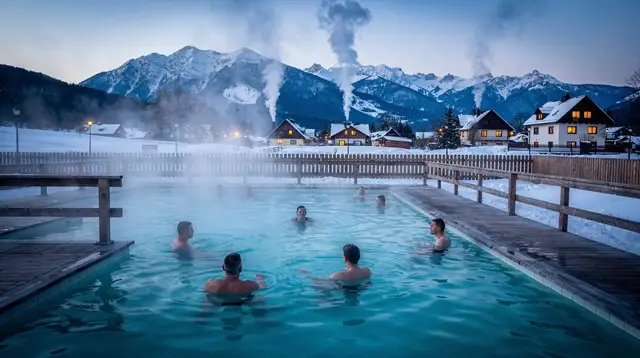
None of it needs a car or a booking window the way Morskie Oko or Kasprowy Wierch do - which makes it a good slow morning to pair with something that does need planning, like a soak at the thermal baths after a day of walking. If a shared day trip from Kraków that includes Zakopane and a stop at the hot springs is on your itinerary anyway, building in an hour for Villa Koliba costs almost nothing and changes how the rest of the town reads.
For a longer stay, a full day combining Zakopane and the thermal baths from Kraków leaves enough slack to walk the older streets slowly rather than rush them, and a day trip that pairs Morskie Oko with time in Zakopane itself works well if the mountains are the priority and the architecture is the bonus.
A two-day weekend in Zakopane leaves room for both without having to choose. Either way, the wooden villas aren’t background scenery for the mountains behind them - they’re the reason the town in front of the mountains still looks like somewhere in particular.
If your trip includes a stop at the baths regardless, a half-day at Zakopane’s thermal baths slots in easily after a morning spent on foot, and it’s exactly the kind of low-effort addition that rounds out a first visit without competing for the same hours as the national park. For planning the rest of the stay around it, I’d start with how many days a first Zakopane trip actually needs, then build the architectural half-day into whichever one has the least mountain weather risk - Villa Koliba and the chapel don’t care if it rains.
tours.Explainer
Verified deep-linked GetYourGuide tours. Book through these links and we earn a small commission at no cost to you.
GetYourGuide does not provide a product photo for this activity — the image shows the meeting point, photographed by us.