Zakopane Is Not an Alpine Resort
I once had a reader write to me from the Kraków airport, three days into a Polish trip, asking where the rest of the ski resort was. She had booked four nights in Zakopane picturing something like a compact Chamonix: lifts fanning out in every direction, a gondola every few hundred metres, a village built entirely around the pass. She had walked the length of Krupówki, ridden the funicular, and was still looking for the part where Zakopane turned into a ski domain. It doesn’t. That mismatch — between the label “winter capital of Poland” and what the town actually is — is the single most common wrong assumption I hear, and it’s worth untangling before you book anything.
A title earned by history, not by terrain
Zakopane has called itself Poland’s winter capital for the better part of a century, and the claim is fair on its own terms. The Wielka Krokiew ski jump has hosted competitive jumping since 1925 and still draws the FIS World Cup every January. The town gave Poland its ski culture, its mountain rescue service, and its first wave of winter tourism. None of that makes it large. Walk out from the town centre in any direction and you find the edge of town within twenty minutes.
This is a place of roughly 27,000 residents sitting between 830 and 1,000 m, with a single pedestrian street, Krupówki, running about 1.1 km through the centre, lined with wooden villas built in the Zakopane style rather than the glass-and-concrete hotel blocks you’d expect from an Alpine base station. The winter-capital title describes what Zakopane means to Poland, not the size of what it offers a skier.
One real mountain, and it’s not a domain
Here is the fact that resets most people’s expectations: Zakopane has exactly one area of genuine high-mountain skiing, and it is a single cable car, not a network. Kasprowy Wierch, accessed from the Kuźnice cable-car base, climbs to 1,987 m with 973 m of vertical and a handful of runs and off-piste-adjacent routes near the top — respectable for a day, but nothing like the lift-linked valleys of the Alps. I’ve written a full breakdown of what the mountain actually offers in the Kasprowy Wierch skiing guide, and the short version is: it’s excellent for what it is, and what it is is one mountain.
Everything else nearby is smaller still. Harenda, close to town, is a gentle hill with night skiing and a chairlift, good for an evening rather than a day. Szymoszkowa and Nosal are beginner terrain, the kind of slopes you’d use to teach a child to snowplough, not to chase vertical. If you widen the search to the whole region, the guide to Białka Tatrzańska’s Kotelnica area covers the largest single ski area nearby, with around 20 km of pistes — respectable for Poland, modest by the standard of an Austrian or Swiss valley with fifty lifts.
I lay all of these out side by side in a full comparison of Zakopane-area ski resorts, and the comparison only confirms it: there is no version of this region where you get Alpine scale. The Kasprowy Wierch cable car guide is worth reading too, mostly because the tickets are dated, timed and prone to selling out — the opposite of the walk-up lift pass you’d expect from a resort built for volume skiing.
The mountains around it are a park, not a piste map
The deeper reason Zakopane can’t become an Alpine-style resort is that it isn’t allowed to. Tatra National Park covers 211.6 km² around the town, and inside it the rules are strict: marked trails only, no off-piste movement, no wild routes between valleys. That applies to skiers as much as to hikers. There is no ski-touring network threading between Rysy, Giewont and the ridges the way there might be in a comparable Alpine valley — the park exists to protect the chamois, the marmots and the roughly 180 brown bears that live here, not to serve a ski industry.
I go into what that means for anyone hoping to explore beyond the marked routes in the Tatra mountain safety guide, and the Zakopane winter season guide covers what actually is open in a normal winter, since some high trails close outright from November to mid-June.
None of this makes winter here dull — the guide to Polish winter school holidays and crowds explains why the town still fills up completely from mid-December through February — it just means the mountain time is concentrated into one good cable car ride, some sleigh rides, and a lot of walking rather than a week of resort-hopping. If your idea of a winter mountain holiday is purely about ski terrain, the night-skiing guide to Zakopane’s beginner slopes is a fair preview of the ceiling: pleasant, local, and modest.
What the trip is actually built around
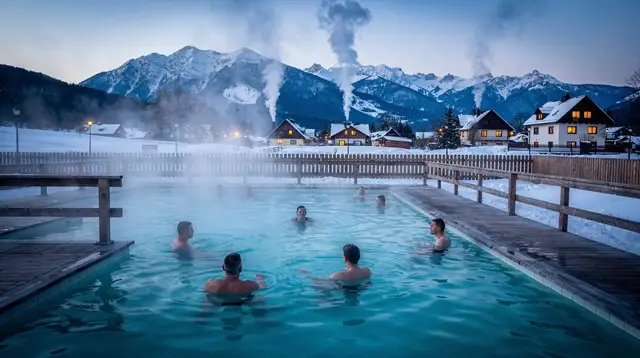
Once you stop expecting a ski domain, Zakopane makes a lot more sense. A typical two or three days here mixes one ride up Kasprowy Wierch, an afternoon on Krupówki (the Krupówki half-day walk guide is a decent way to plan that half day without wasting it), and — more than most visitors expect — an evening at a thermal bath. The region sits on genuinely hot groundwater, and the baths are as central to a Zakopane trip as the mountain is.
On a cold January evening I’d rather book the Zakopane thermal baths outside town than queue for a second lift pass, and plenty of visitors coming from Kraków treat it the same way, joining a day tour from Kraków that pairs Zakopane with the hot springs rather than building a whole ski trip around it.
If you want the full comparison of where to soak, the thermal baths comparison guide covers Chochołów, Białka Tatrzańska and the smaller options, and the Chochołów spring pools with a local tasting is the version I send people to when they want the baths and a taste of Podhale food in one afternoon.
If you’re still deciding between the Polish and Slovak sides, the Zakopane-versus-Slovak-Tatras comparison is worth reading before you commit — the Slovak Tatras have their own small ski areas, not a bigger version of what Poland offers, so crossing the border won’t solve the Alpine-scale problem either.
And if you’re building a first trip from scratch, the guide on how many days to spend in Zakopane and the rundown of Zakopane’s tourist-trap mistakes both start from the same premise this piece does: come for a mountain town with one great cable car, a national park, and hot water underground — not for a resort it was never built to be.
tours.Explainer
Verified deep-linked GetYourGuide tours. Book through these links and we earn a small commission at no cost to you.
GetYourGuide does not provide a product photo for this activity — the image shows the meeting point, photographed by us.