Horse Riding in Zakopane and the Tatra Foothills
Can you go horseback riding near Zakopane?
Our records document two horse-drawn traditions in the Zakopane area, not saddle riding: the fasiąg, a horse carriage that covers part of the walk from Palenica Białczańska toward Morskie Oko, and the kulig, a horse-drawn winter sleigh ride offered as an evening custom from December to March. We have no verified data on riding stables, trail rides, or lesson centres, so treat any such claim as something to confirm locally rather than something we can vouch for.
What our records actually say about horses here
Search “horse riding Zakopane” and you will find plenty of pages promising trail rides through pine forest with mountain views. We are not going to be one of them, at least not on the strength of what we can verify. Our source material on Zakopane and the surrounding Tatra National Park documents exactly two uses of a horse in this region, and neither one is a saddle.
The first is the fasiąg, the horse-drawn carriage that works the access road toward Morskie Oko. The second is the kulig, the horse-drawn winter sleigh that carries groups through the snow to a highlander feast. Both are real, both are bookable in some form, and both put the horse in front of you pulling a vehicle rather than under you carrying your weight. If you came here hoping for a page about riding lessons, guided forest treks on horseback, or a stable with a name and a price list, we would rather say so plainly than write around a gap in the data. What follows sticks to what is documented, and points you toward how to check the rest yourself.
The fasiąg: the carriage to Morskie Oko
Anyone walking to Morskie Oko from the Palenica Białczańska car park has three ways to cover the 9 km of paved road: on foot, by rented bicycle where allowed, or behind a horse. The fasiąg is that third option — a two-horse carriage that runs passengers from Palenica up to Włosienica, a meadow about 1.5 km short of the lake, where the paved road effectively stops being carriage-friendly and the last 20 minutes become a walk regardless of how you arrived.
This is not a scenic loop or a tourist novelty ride through a forest of the operator’s choosing. It is a working shuttle on a fixed, single road, moving people who would otherwise walk it. The horses pull a wagon with bench seating for a dozen or so passengers, not a saddle, and there is no version of this service where you sit astride the animal.
What we can confirm about the fasiąg:
| Detail | What the record shows |
|---|---|
| Route | Palenica Białczańska → Włosienica, on the paved TPN access road |
| Distance covered | About 7.5 km of the 9 km to the lake |
| Remaining walk | Roughly 20 minutes on foot from Włosienica to Morskie Oko |
| Price (uphill), 2026 | Roughly 80–100 PLN |
| Price (downhill), 2026 | Somewhat less than uphill |
| Booking | No advance reservation system; carriages queue at Palenica, and queues form early in season |
| Season | Whenever the road to Palenica is open and carriages are running; busiest July–August |
We cover the fasiąg in more depth, including how it compares to walking the whole way, in Morskie Oko: carriage or walking and in the full Morskie Oko visitor guide. If your only interest in “horses near Zakopane” is getting to the lake with less walking, this is the one documented, real answer — and it is worth reading why the Morskie Oko car park needs reserving in advance before you plan the day around it, since the carriage does nothing to solve that separate bottleneck.
The kulig: a winter sleigh, not a saddle
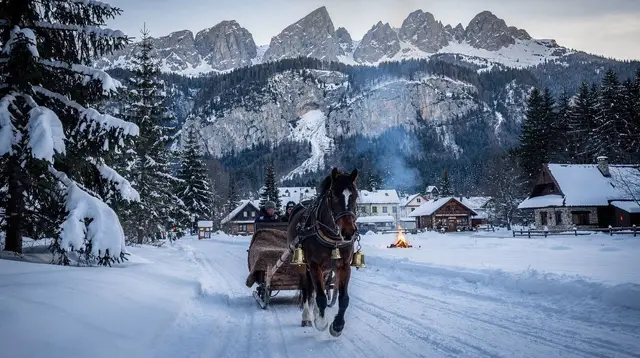
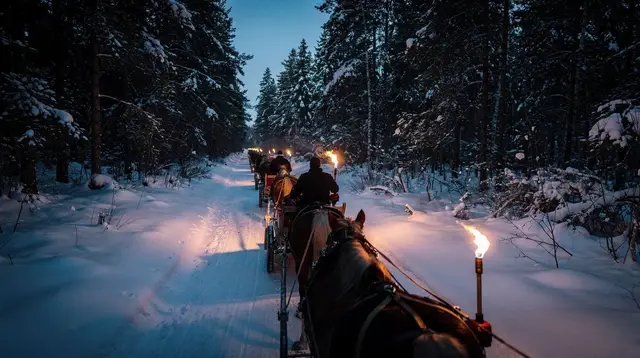
The second documented use of a horse in this region is entirely seasonal and entirely different in character. A kulig is a traditional Podhale winter outing: a horse-drawn sleigh, usually one of several strung together, carrying a group across snow-covered countryside to a highlander hut for food, music from a Górale string band, and a bonfire. It is a custom rooted in the region’s highlander culture, not an activity built for exercise or skill.
Sold commercially, a kulig runs as an evening excursion from around December to March, weather and snow cover permitting — it depends on there being enough snow on the ground for a sleigh to run, which is why it is a winter-only proposition and not something you can book in June. You sit in the sleigh, wrapped against the cold; the horses do the work. It shares a stable and a set of harnesses with the fasiąg in spirit, but not a route, a season, or a purpose.
a Tatra Mountain sleigh outing from Kraków that runs on this same horse-drawn winter tradition is the closest thing to a kulig you can currently reserve online in a structured, ticketed form, with the food-and-bonfire elements varying by operator. We go into how a kulig actually runs, and how it differs from the summer carriage, in the traditional kulig sleigh ride guide and in sleigh ride versus horse carriage: the difference.
If you are planning a winter trip and want to know whether a kulig fits your dates, start with the Zakopane winter season guide or, for the busiest stretch of the calendar, the Christmas and New Year guide and the matching Zakopane winter, 3 days itinerary.
Why we stop there
It would be easy to pad this page with a “top 5 riding stables around Zakopane” list, complete with prices, difficulty levels and recommended ages. We are not going to do that, because none of it would come from anything we have actually verified. The Podhale has kept working horses for generations — you see them pulling carts and, in winter, sleighs, around the villages — and it would not be surprising if a riding stable or two operates somewhere between Zakopane, Kościelisko and the wider Podhale. “Would not be surprising” is not the same as “confirmed,” and a name, a price and a skill-level recommendation invented to fill a gap is worse than admitting the gap.
What we will not do here: name an equestrian centre we have not verified, quote a price per hour for a trail ride, suggest a required riding level, or describe a route through the forest as though we had ridden it. If you find such a listing elsewhere, the questions worth asking before you pay are the same ones that apply to any unfamiliar activity operator in a small town: is there a physical yard you can see, a phone number that gets answered, reviews with dates and details rather than a single generic star rating, and a clear answer about helmets and insurance.
None of that is specific to horses — it is the same due diligence the list of Zakopane tourist-trap mistakes applies to other loosely regulated activities in town.
Where the Górale culture fits in
Horses in this region are inseparable from the Górale, the Podhale highlanders who have kept their own dialect, dress and music through the region’s tourism boom. The kulig is one of their customs commercialised for visitors, usually paired with an evening of live highlander music around a fire — the same evenings covered in highlander fire and music nights — and often with oscypek, the smoked sheep’s cheese of the region, served at the hut.
A horse pulling a sleigh through snow to a mountain hut is as much a piece of Górale heritage as the embroidered trousers and the string band waiting at the other end, which is part of why we treat the kulig as a cultural evening first and a horse activity second.
a fully customisable private Tatra and Zakopane day, arranged around what you actually want to see is one way to fold a highlander-culture stop, a kulig in season, or a visit to Morskie Oko’s carriage road into a single planned day rather than piecing it together on the ground; a private guide can also tell you, on the spot and with current information, whether a riding stable near your base is worth the visit — something no guidebook page can promise months in advance.
The one tour that does mention riding
There is one bookable product in the current catalogue that names horseback riding directly, and it is worth being precise about what it is:
a Kraków-based day combining a horseback outing, a sheep’s cheese tasting and the Zakopane cable car is sold as a packaged day trip rather than an independent riding-centre visit, and it bundles the ride with two other activities rather than offering hours of open trail time.
We are naming it because it is a real, currently listed product, not because our own source material describes the stable, the route, the terrain or the skill level involved — for those specifics, read the tour’s own listing before booking, the same way you should for any activity where our page is pointing you to a third-party operator rather than to something we have independently verified. If riding is the main reason for your trip rather than a side element of a packed day, it is worth reading the listing closely and, where possible, messaging the operator directly with questions about horse size, experience required and group size before you commit.
For travellers whose real interest is simply “an active day in the Tatra foothills” rather than riding specifically, a guided hike through the Tatra foothills with hotel pickup included or a broader full day trip through Zakopane and the Tatra Mountains from Kraków cover similar ground without resting on a riding component we cannot independently confirm.
Practical notes: what to actually check before you book
If you are set on riding a horse — not a carriage, not a sleigh — around Zakopane, treat it as an independent research task rather than something this guide, or most guides, can hand you ready-made. A short checklist:
- Confirm the activity, not just the word “horse.” A kulig, a fasiąg and a saddle ride are three different things that all involve a horse; make sure the listing you are looking at matches what you actually want to do.
- Ask for the yard, not just the pickup point. A legitimate stable will let you see the horses and the tack beforehand, in person or in recent photos with a visible location.
- Get a season and weather answer. The kulig only runs with snow on the ground, roughly December to March; a saddle ride, if you find one, may have its own seasonal limits tied to mud, heat or hay season that a local operator can explain better than we can.
- Check for a helmet and a fitting, not just a horse. This applies to any riding activity anywhere, and it is a fair question to ask before you pay a deposit.
- Use your accommodation as the filter. A guesthouse or hotel in Zakopane, Kościelisko or the wider Podhale will generally know which local stables are active and reputable this season — that is more current than anything printed months in advance.
- Treat park boundaries as fixed. Whatever you arrange, do not expect to ride inside Tatra National Park itself; the park’s documented rules keep hikers to marked trails and its ticketing applies to foot traffic, and nothing in our records describes a horse-trail network inside the park boundary beyond the Morskie Oko access road the fasiąg uses.
Frequently asked questions about horse riding near Zakopane
Can I go horseback riding near Zakopane?
Not in a verified, bookable sense beyond one packaged tour that pairs a ride with a cheese tasting and the cable car. What our sources document reliably is riding behind a horse, not on one: the fasiąg carriage on the Morskie Oko road, and the kulig sleigh in winter. Anything beyond that should be checked locally before you plan around it.
What is a fasiąg, and where does it operate?
A fasiąg is a horse-drawn carriage working the paved road between the Palenica Białczańska car park and Włosienica, shortening the walk toward Morskie Oko lake by about 7.5 of its 9 km.
How much does the Morskie Oko horse carriage cost?
Roughly 80 to 100 PLN uphill and somewhat less downhill, based on 2026 figures, paid on the spot — treat it as a reference rather than a guaranteed current rate, since these carriages set their own prices.
What is a kulig, and when can I do one?
A kulig is a traditional Podhale horse-drawn sleigh ride, typically ending at a highlander hut with food, music and a bonfire, sold roughly from December to March depending on snow cover.
Is a kulig the same as horseback riding?
No — you ride in a sleigh pulled by horses across snow, in a group, rather than sitting in a saddle.
Are there horse riding stables in Zakopane?
Quite possibly, informally, but our source material does not document a specific stable, price or skill level, so we are not naming one here — ask locally, ideally through your accommodation.
How do I check whether a riding stable is legitimate before booking?
Ask to see the yard and the horses, confirm a real phone number and address, look for dated and specific reviews, and confirm helmets are provided and fitted before you pay anything.
Can I ride a horse inside Tatra National Park?
Our records do not document mounted riding as a permitted activity inside the park itself; the one documented horse-drawn route, the fasiąg to Włosienica, runs on the access road at the park’s edge, not on the marked hiking trails within it.
Horse riding tours
Verified deep-linked GetYourGuide tours. Book through these links and we earn a small commission at no cost to you.
GetYourGuide does not provide a product photo for this activity — the image shows the meeting point, photographed by us.