Tatras on a Budget: 3 Days by Bus, Hut and Milk Bar
Where the money actually goes on a Tatras trip
A budget Tatras trip is not about skipping the mountains. It is about choosing which costs to pay and which to walk past. The four levers that matter most on a three-day route are the bus instead of the train from Kraków, a milk bar instead of a Krupówki restaurant, your own legs instead of a minibus fare to Kuźnice, and a mountain hut bed instead of a second cable car ticket.
One cost never gets cut: the Tatra National Park entry ticket. It applies on every marked trail inside the park, including the flattest, cheapest, most obviously “free-feeling” ones, at 11 PLN standard and 5.50 PLN reduced (2026 prices), bought online at tpn.gov.pl or at the trailhead booth. There is no version of this itinerary where that ticket is optional.
This plan covers Zakopane town, the walk up to Kuźnice and the Kasprowy Wierch decision point, and the Kościeliska valley — three areas, three days, one park ticket bought each day you’re on a trail. For the longer, car-free version of this route see the car-free 4-day Tatras itinerary; for the general logic of keeping costs down across a whole trip, see the Zakopane budget guide.
Day 1: Kraków to Zakopane by bus, and a milk-bar dinner
Buses between Kraków and Zakopane run all day, more than fifty departures, and on many slots they undercut the train — the opposite of what first-time visitors assume, who default to the train out of habit. The ride takes roughly 2 to 2.5 hours depending on traffic on the Zakopianka, the single road that carries almost everyone south. For the full comparison of bus, train and driving yourself, read bus vs train vs the Zakopianka and the companion piece on why the road itself is the real variable. Book a morning departure if you can: it lands you in Zakopane with a full afternoon still ahead, rather than arriving as shops close.
Drop your bag at whatever budget guesthouse or hostel you’ve booked — Zakopane has plenty outside the immediate Krupówki strip, where rates are noticeably lower a few streets back — and walk Krupówki itself for free. It costs nothing to look: the wooden villas, the street musicians, the oscypek stalls. What costs money is sitting down at a restaurant table on that street, where prices are built for one-time tourists, not for three-day budgets. Save the appetite for dinner and read where to eat without the tourist-trap prices before you choose where.
For dinner, find a bar mleczny — a “milk bar,” the old-style Polish canteen that still runs on a subsidised, cash-and-tray model: point at what’s in the counter, pay at the till, eat where the locals eat. A full plate of pierogi, kwaśnica or a hot meat-and-potato plate costs a fraction of anything on Krupówki, and the food is not a downgrade — it’s simply not styled for tourists. This single choice, repeated for three evenings, is the biggest line-item saving in the whole trip; the budget guide covers where the nearest ones sit relative to the centre.
Before bed, buy tomorrow’s Tatra National Park ticket online rather than queuing at the trailhead booth — in July to September the online quota can sell out days ahead, and a 5-minute purchase tonight avoids a wasted morning. The mechanics of TPN tickets, Morskie Oko car park reservations and Kasprowy Wierch cable-car slots are all covered together in booking Morskie Oko, Kasprowy and TPN tickets, worth reading once before this trip rather than improvising at 8am.
Day 2: walk to Kuźnice, then choose — cable car or a hut on the ridge
Kuźnice, the base station for the Kasprowy Wierch cable car and the trailhead for half the routes into the high Tatras, is closed to private cars. Most visitors take a minibus from the centre. Walking instead takes 30 to 40 minutes on a signed path and costs nothing — the single easiest saving of the whole itinerary, and it doubles as your warm-up. The route and the minibus alternative (worth knowing for a bad-weather day) are both in the Kuźnice and the valley minibuses guide; for the area itself see Kuźnice and Kasprowy Wierch.
At Kuźnice the trip forks, and which fork you take is a genuine budget decision, not a formality.
If the budget stretches to it, ride the Kasprowy Wierch cable car outside the priciest booking window. Tickets are dated, timed and sold online up to two hours ahead, and they do sell out on clear days — this is never a walk-up, spontaneous ride. Prices move with the season and the slot: roughly 99 to 165 PLN return online in high season, about 129 PLN in low season, with “express” departures costing more (2026 figures). Off-peak departures — early morning, or well after the first summer rush — sit toward the cheaper end of that range.
It is never free and it is never guaranteed; the full mechanics, including what happens on windy days when the whole system stops, are in the Kasprowy Wierch cable car guide. Combine the ride with an afternoon in town, or with a booked half-day out — a day trip through Zakopane and the Tatra Mountains bundles transport and a guide if you’d rather not plan the logistics yourself.
If the budget is tighter, skip the cable car entirely and walk instead. From Kuźnice, the marked trail climbs to Hala Gąsienicowa, a high meadow basin ringed by peaks, and on to the Murowaniec mountain hut for the night. A hut dorm bed costs a fraction of a second town-centre night plus a cable car ticket combined, and it puts you inside the park at altitude for sunset and sunrise — something no day visitor gets. Buy your own food to carry up or eat simply at the hut kitchen rather than ordering the full menu; huts are not restaurants, and treating them as basic shelter rather than a treat is what keeps this option cheap.
What a hut night actually involves — bunks, shared facilities, no wild camping alternative inside the park — is covered in sleeping in the mountains: the schroniska system and the fuller multi-day hut-to-hut planning guide. The Tatra ticket you bought last night covers this trail; it is required here exactly as it is everywhere else in the park.
Either way, note the rescue number before you go up: TOPR, the Tatra volunteer rescue service, is reachable on 985 or +48 601 100 300, or 112, and rescue in Poland — including by helicopter — is free of charge. Weather turns fast above the treeline; the Tatra mountain safety guide is worth five minutes before either fork of this day.
Day 3: the Kościeliska valley from Kiry, on foot
The Kościeliska valley is the cheapest full day this itinerary offers, and one of the best — a long, gentle, paved track that needs no technical gear and no booking. Reach the entrance at Kiry, about 8 km west of Zakopane (a short, inexpensive minibus hop, or a walk down from the hut if you slept at Murowaniec the night before and are routing back through town first). From Kiry it’s roughly 9 km of flat, paved valley floor — prams and unfit knees manage it without trouble — past the Mroźna and Raptawicka caves and on to the Ornak hut, a sensible turnaround point or lunch stop before walking back the same way.
The only cost here is the one that repeats every day in the park: the TPN entry ticket, 11 PLN standard or 5.50 PLN reduced. There is no version of this valley that is free simply because it’s flat, unstaffed at the gate, or feels like a normal footpath rather than an “attraction” — the ticket applies on every marked trail in the park, Kościeliska included, and skipping it is not a legitimate saving. The Kościeliska valley family-hike guide has the trail timings and the cave details in full.
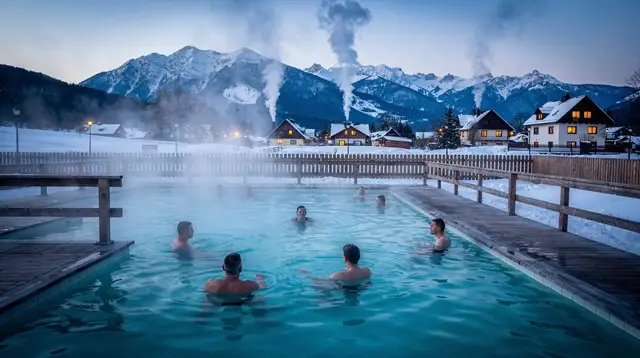
Back in Zakopane by mid-afternoon, there’s time for a last walk of Krupówki, a final milk-bar meal, and the return bus to Kraków — booked, again, for whichever slot beats the train price that day. If legs are tired and the budget has a little slack left after three days of walking instead of riding, a short soak is the one splurge worth considering before an evening bus: a shared trip to the Zakopane hot springs runs from town without needing your own transport, and even a single evening session at the thermal baths is priced lower than a full day pass.
What each choice actually costs
| Choice | Cost (2026) | What it replaces |
|---|---|---|
| TPN entry, one day | 11 PLN standard / 5.50 PLN reduced | Nothing — required on every trail, every day you’re on one |
| TPN entry, 7 days | 55 PLN | Buying single-day tickets repeatedly on a longer trip |
| Kasprowy Wierch cable car, return | ~99–165 PLN high season online, ~129 PLN low season | A full day’s walk up and down on foot |
| Gubałówka funicular, return | ~37–49 PLN | Skipped in this itinerary — Krupówki and the free viewpoints cover the same ground for less |
| Walk from centre to Kuźnice | free, 30–40 minutes | The minibus fare each way |
| Mountain hut dorm bed | set by the individual hut, well under a hotel room | A second night of town accommodation plus a cable car ticket |
Budget tips that make the biggest difference
- Book buses for off-peak slots where fares run below the train, rather than defaulting to whichever departure looks fastest — see the bus vs train comparison.
- Eat where locals eat. A bar mleczny meal costs a fraction of the same dish on Krupówki, and repeating that choice for three dinners is the single largest saving in this itinerary.
- Walk instead of ride whenever the distance allows it — Kuźnice is the clearest example, but the same logic applies to short hops around town.
- Buy the TPN ticket online the night before, not because it’s cheaper, but because the online quota can sell out in peak months and a queue at the booth wastes a morning.
- Choose a hut night over a second cable car ride when funds are tight — it’s cheaper than the ticket alone, and it adds a mountain sunrise the day-trip version of this route never sees.
- Treat the thermal baths as an optional last-day extra, not a fixed cost — an evening session is priced below a full day pass if you do decide the legs have earned it.
FAQ: doing the Tatras on a budget without cutting corners on safety
Is the Tatra National Park entry ticket ever optional if I stick to easy, flat trails?
No. The ticket applies on every marked trail inside the park boundary, including the paved, gentle Kościeliska valley walked on Day 3. It costs 11 PLN standard or 5.50 PLN reduced in 2026, bought online at tpn.gov.pl or at the trailhead booth, and it is required regardless of how easy or “unattended” the trail feels.
Is the Kasprowy Wierch cable car ever free, or free off-peak?
No. It is a paid, dated and timed ticket in every season, roughly 99 to 165 PLN return in high season online and about 129 PLN in low season (2026), with cheaper slots outside the busiest booking windows but no free window at any time. Tickets sell out on clear days, so it is never a spontaneous, walk-up ride.
What exactly is a bar mleczny, and is the food actually good?
A bar mleczny — “milk bar” — is a Polish self-service canteen dating back decades, still running on simple, subsidised pricing: point at the counter, pay at the till, eat at a plain table. The food is traditional home-style Polish cooking — pierogi, kwaśnica, potato dishes — not a downgrade from a restaurant, just built for locals eating daily rather than tourists eating once.
Do I need a car for this three-day route?
No. Every leg — Kraków to Zakopane, into Kuźnice, out to Kiry for the Kościeliska valley — runs on the bus and minibus network, and walking covers the short hops. A car adds cost (fuel, Zakopianka traffic, no parking at Kuźnice) without shortening this particular route.
Is a mountain hut dorm safe and comfortable enough for a first-timer?
Yes, within realistic expectations: shared bunk rooms, shared bathrooms, simple food, no private luxury. It is basic mountain shelter, not a hotel substitute, and it is the standard way hikers overnight inside the Tatras — wild camping and bivouacking are banned throughout the park, so a hut is the only legal option above the valley floor.
Can this three-day budget route be done in winter?
Not as written. High trails, including the approach to Hala Gąsienicowa used on Day 2’s hut option, close from around 1 November to mid-June, and the Kasprowy Wierch cable car itself shuts for maintenance in late autumn and part of spring. A winter version of this trip stays lower and swaps the hut night for a town-based itinerary instead.
Is walking to Kuźnice actually faster than waiting for a minibus?
Often close to the same door-to-door time once queueing and the short ride itself are counted, and the walk costs nothing. On a clear morning it’s the better choice outright; in poor weather or with heavy gear, the minibus is worth the fare.
Popular day trips
Verified deep-linked GetYourGuide tours. Book through these links and we earn a small commission at no cost to you.
GetYourGuide does not provide a product photo for this activity — the image shows the meeting point, photographed by us.